
WebbifyStudio

Industries · Industrial and technical services

Industrial website design and SEO for services that are hard to explain and hard to find

Technical B2B companies often have a site that describes their equipment in depth while the buyer is searching for a job to be done. Webbify restructures the site around what buyers actually search for, explains the service clearly, and builds a lead path a project manager can use. Grounded in the NanoVapor project.

What is different

Three problems most industrial sites share.

Product-first positioning, pages that overlap, and contact flows designed for the company rather than the buyer.

Explain the service, not just the equipment

Industrial sites often describe the technology in detail and leave the buyer to work out what problem it solves. Buyers search for the outcome they need. The site has to lead with the service and let the equipment support it.
Structure around how buyers search

Facility managers, contractors, and compliance teams search for a specific job, a specific condition, or a specific question. Each of those deserves a page, and closely related terms belong on one page rather than spread across near-duplicates.

A B2B lead path that respects the buyer

Industrial purchases involve project details, timelines, and several stakeholders. The contact flow should collect what a quote needs and no more, and the content should give a project manager enough to brief their own team.

Page architecture

The structure a technical-services site needs

This is the architecture Webbify planned for NanoVapor and would start from for a comparable industrial company. The rule is one meaningful need per page and no page that exists only to hold a keyword.

  • A primary service page for the core offering, explaining the process, common use cases, and what the customer should expect
  • Supporting service pages only where the need is meaningfully distinct, not one page per synonym
  • Application pages organized around real jobs: inspection, repair, removal, closure, maintenance
  • Educational pages that answer the informational questions buyers ask before they request a quote, linked to the commercial pages
  • A technology or equipment section that supports the service pages rather than leading the site
  • Press, media, and video organized with sources identified and self-published content labeled as such
  • A request-a-quote flow that captures project location, scope, and timeline without overwhelming the user

In practice

NanoVapor: from equipment listings to the services buyers search for.

An industrial vapor-management company. The project is currently a prototype; the strategy and architecture work is what this page describes.

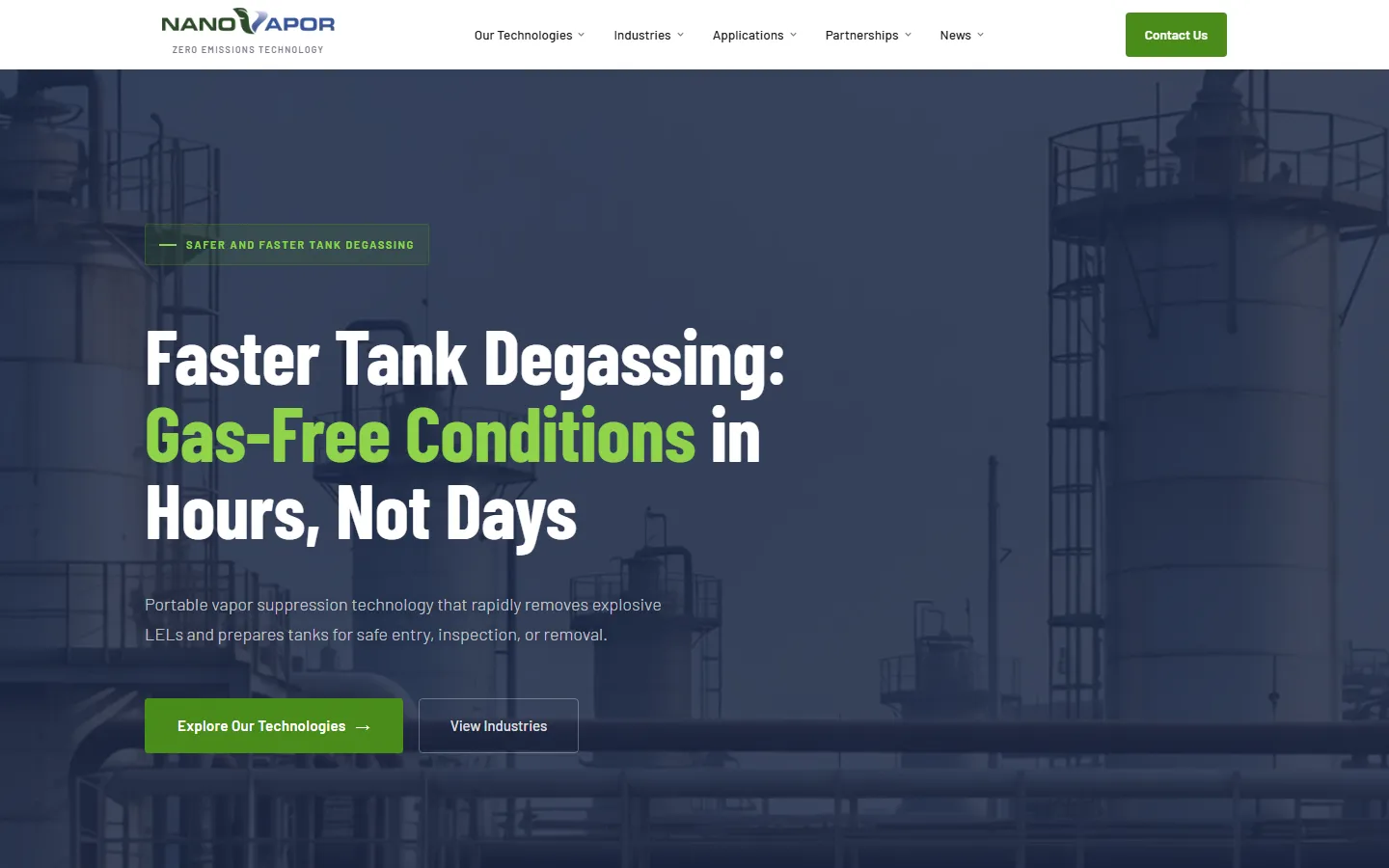
NanoVapor’s services involve underground storage tanks, fuel systems, vapor removal, and tank purging. The existing positioning led with the equipment. Search-intent research showed that prospective customers were looking for the outcome: degassing a tank before inspection, repair, removal, or closure, reducing vapor readings, or reaching gas-free conditions.

Webbify’s work restructured the strategy around underground storage tank degassing and related service intent. That meant a primary service page for the core offering, supporting pages only where the need was distinct, application pages organized around real jobs, and educational content for the questions buyers ask before requesting a quote. Technical content was reorganized for decision-makers without stripping the detail an engineer would look for.

Webbify also worked on the technical service pages, technical SEO and internal-linking foundations, media and press organization, and conversion paths, with a staging environment supporting the build. The initial geographic focus was Houston and Texas, with no location pages created for areas where service availability was not verified.

Handled with care

What Webbify does not publish on an industrial site

  • Safety, compliance, emissions, speed, and performance statements are published only when the client can document them; Webbify does not infer technical specifications from marketing language
  • Client and partner relationships are named only with written authorization and exact approved wording
  • Location pages are created only for areas where service availability is verified, never as city-swapped duplicates
  • The website does not guarantee availability, response times, project duration, or pricing unless the client has approved those commitments
  • Where a project is a prototype or still in staging, Webbify says so rather than presenting it as launched

Questions

What technical-services companies ask.

Our service is highly technical. Can a web studio explain it accurately?

Yes, if the studio does the work of understanding it and treats every technical claim as something to verify with you rather than paraphrase from marketing copy. Webbify writes for the decision-maker while keeping enough detail for the engineer, and nothing technical is published without your review.

Should we build separate pages for every city or state we serve?

Only for areas where service is verified and where the page can say something specific. Thin pages that swap one city name for another are treated as low-quality by search engines and give buyers nothing. A strong primary service page with clear service-area information usually does more.

How do you find out what our buyers actually search for?

Search-intent research: query data, Search Console where a site already exists, competitor pages, and conversations with you about how inquiries are actually phrased. For NanoVapor, that research showed buyers were searching for the service outcome, not the equipment, and the architecture followed.

What should an industrial contact form ask for?

Enough to scope a quote: company, contact, project location, the asset or system involved, the service requested, and the timeline. Long forms lose serious buyers; short ones generate inquiries you cannot act on. The balance is set with you based on what your team needs to respond.

Does your site explain the equipment but not the job?

Request a site review. Webbify looks at how buyers search for what you do, how the current site is structured, and where the two diverge, then explains what is worth changing.