
Case study · Custom application
Building a veterinary case-review platform that works in stages.
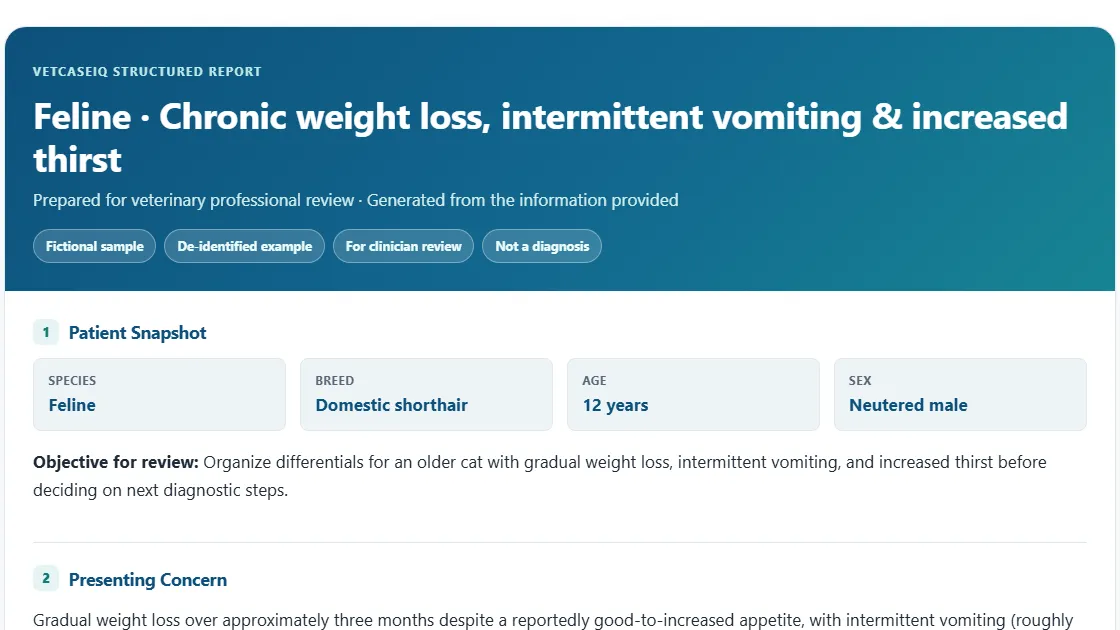
VetCaseIQ was conceived, designed, developed, and is operated by Ian Lehrer. It helps veterinary professionals organize complex case information, review diagnostic possibilities, see supporting and conflicting evidence, surface missing information, and retrieve relevant literature. It is Webbify's own product, included here because it shows what a custom application from this studio looks like end to end.
- Industry
- Veterinary technology, Ian Lehrer's own product
- Scope
- Product strategy, workflow design, multi-stage processing pipeline, document processing, literature retrieval, QA design, cloud deployment
- Status
- Live
- Outcome metrics
- Not published
The application is live and under active development and testing. No accuracy statistics, user counts, or outcome figures are published.
The challenge
Veterinary cases arrive as fragments. Clinicians need them as a structure.
Signalment, history, labs, imaging, referral notes, and prior treatments rarely show up in one tidy document.
A complex case is spread across laboratory reports, medical records, imaging reports, cytology descriptions, and referral paperwork, often from several dates. Reviewing it means holding all of that in mind at once, noticing what conflicts, noticing what is missing, and checking the literature for anything unusual. That is slow, and the most consequential errors are the diagnoses that never got considered.
The product goal was a reviewable workflow: turn fragmented clinical information into a structured report a veterinarian can read, question, and check. It is built to support clinical reasoning and case review. It is not designed to replace veterinarians, provide diagnoses on its own, or make treatment decisions without professional judgment, and its outputs are framed that way throughout the product.
The decision
Why a one-pass summary was not good enough.
A single block of summary text is the wrong shape for high-stakes information. The system had to show its work.
Summarizing a case in one pass produces a fluent paragraph. It does not produce a problem list, a separation of evidence for and against each differential, a list of what is still unknown, or references that can be opened and read. VetCaseIQ uses a multi-stage pipeline instead of a single summary, so each stage can be inspected and improved on its own. This is the same principle behind Webbify's custom web application work: the workflow is designed first, and every component serves it.
A single pass
- One summary in one pass, with no separation between what the case shows and what is being inferred
- No structured place for missing information, so gaps go unnoticed instead of becoming questions
- Citations that cannot be checked against a real literature source
- No way to review why a diagnosis was ranked where it was
A multi-stage pipeline
- Intake, document structuring, findings, differentials, literature, and QA handled as separate stages
- Supporting, conflicting, and missing findings kept apart so a clinician can see the reasoning
- Literature retrieved through PubMed and Europe PMC rather than generated from memory
- Quality checks on the output before a report is shown, and a case chat grounded in that report
The work
Product design, pipeline engineering, and quality systems, owned by one person.
Product and workflow design
- A guided, multi-step intake covering signalment, history, presenting complaint, exam findings, laboratory results, imaging, cytology or pathology, prior treatments, and uploaded documents
- Report structure and information hierarchy designed for a clinician reviewing a complex case under time pressure
- Follow-up questions generated when information that could change the interpretation is missing
Pipeline and integrations
- Structured document processing that turns lab reports, records, imaging reports, and referral documents into organized case data
- Laboratory extraction that distinguishes current values, historical values, repeated results, and meaningful trends
- A multi-stage processing pipeline that separates supporting, conflicting, and missing findings and flags diagnoses that should not be missed
- Literature retrieval through PubMed and Europe PMC so references are grounded, not fabricated
Engineering and quality
- Built in Next.js, React, and TypeScript with API integrations and custom pipeline logic
- Structured test fixtures, report comparisons, differential-ranking review, and laboratory-consistency checks
- Type checking, linting, production builds, and deployment testing on every iteration
- Cloud deployment and hosting managed by Ian; infrastructure details are intentionally not published
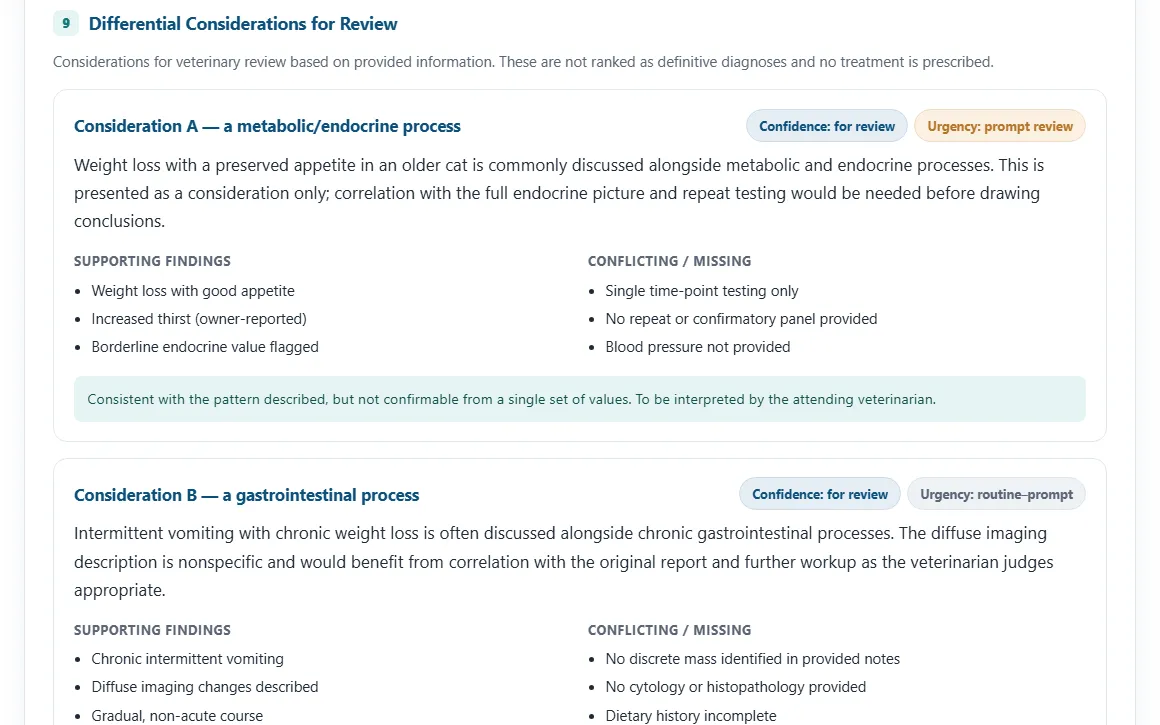
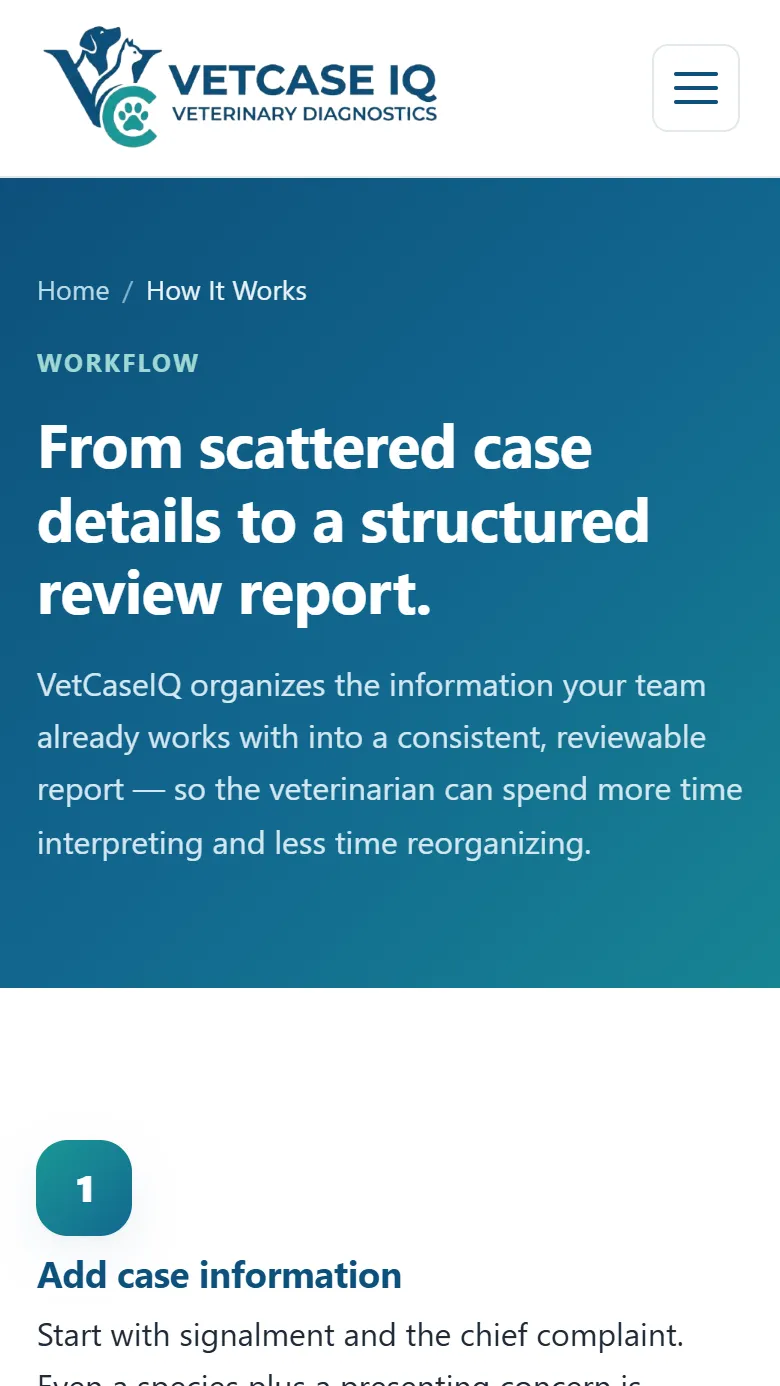
Ian is responsible for product direction, architecture, testing, clinical-output review, and quality control. Live clinical behavior is tested after deployment through the real pipeline, not assumed from a passing build. More on the person behind it on Ian Lehrer's page.
Outcome
A live application, still being refined.
Working end to end, tested against real case material, and honest about its limits.
- A working application with case intake, document extraction, follow-up questions, structured reports, differential review, literature retrieval, case chat, and quality-assurance checks
- Iterative testing against published and representative veterinary cases to evaluate the quality, structure, and usefulness of its outputs
- Session-based case handling, designed so case information is not intentionally kept as a permanent server-side case database
- Ongoing refinement of report speed, output consistency, differential breadth, laboratory trend handling, literature reliability, and diagnostic guardrails
VetCaseIQ has been tested against veterinary case examples involving conditions such as endocrine crises, tick-borne disease, hematopoietic neoplasia, leptospirosis, gastrointestinal and renal disease, and infectious disease, including published educational cases. Using a published case for testing does not imply any institution's endorsement, and no accuracy percentage is claimed. The marketing site is at vetcaseiq.com. What the project demonstrates for Webbify is custom application development, workflow design, structured data processing, literature integration, quality-assurance systems, cloud deployment, and iterative product development, all from one studio.
Need a workflow, not just a website?
Describe the process you want to build around. We will tell you whether it needs a custom application, and what a first version would involve.